There is a familiar story we tell about Juneteenth. President Abraham Lincoln issued the Emancipation Proclamation on January 1, 1863, but the news did not reach enslaved people in Texas until June 19, 1865. For two and a half years, the story goes, they remained enslaved because they did not know they were free.
It’s a powerful story. It’s also too simple.
News of the Emancipation Proclamation had reached Texas. It appeared in newspapers, moved through communities, and was known by at least some of the people held in bondage there. What had not reached Texas in sufficient force was the power to make slaveholders obey it. The proclamation existed. Freedom had been declared. But those who profited from slavery continued to behave as though neither fact mattered.
Freedom was not delayed only because people did not know. It was delayed because powerful people had something to gain from pretending it did not exist.
That distinction matters. The comforting version turns emancipation into a problem of communication, as though freedom were a letter lost in the mail. The more difficult version asks us to confront what happens when a right exists on paper but the people who benefit from violating it retain the power to decide whether it will be honored.
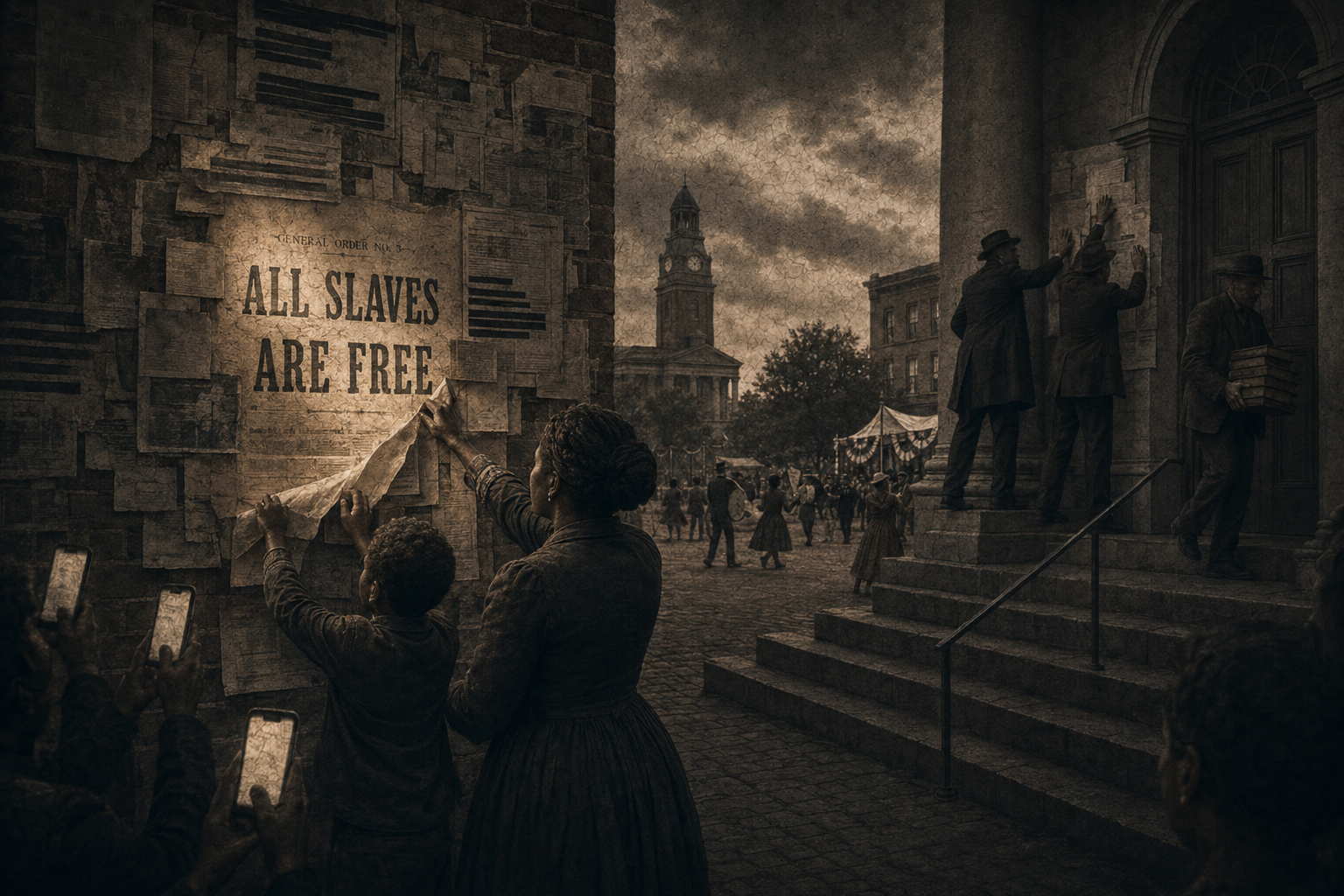
When Major General Gordon Granger arrived in Galveston with federal troops, General Order No. 3 announced that all enslaved people were free and that there would be an “absolute equality of personal rights and rights of property” between former masters and formerly enslaved people. It was an extraordinary declaration. But the order did not end there.
Its next sentences advised freedpeople to remain quietly in their existing homes and continue working for wages. They were told that they could not gather at military posts and would not be supported in idleness. Freedom arrived with instructions. The old relationship of master and slave was formally abolished, but the newly free were immediately directed toward a labor arrangement designed to keep them in their place.
Even the announcement of freedom attempted to contain what freedom might mean.
This is the politics of not knowing. It is not simply the absence of information. It is the organization of the conditions under which information can be understood, believed, shared, and acted upon. A person may know a fact and still be unable to make that fact matter. A population may possess rights and still lack the practical means to activate them.
Knowledge is necessary for freedom, but information alone is not knowledge. Knowledge alone is not power. Knowledge becomes emancipatory only when people can place information in context, recognize its meaning, share it with others, organize around it, and compel institutions to respond.
Those who benefit from inequality understand this, even when they never say it aloud. They do not always need to abolish rights openly. They can weaken the institutions that teach people what those rights are. They can remove the history that explains why those rights were necessary. They can overwhelm the public with so much information that truth becomes difficult to identify. They can make the procedures for asserting a right so complicated that only experts can navigate them. And they can replace substantive freedom with the performance of celebrating it.
They can destroy the conditions of possibility for emancipatory knowledge.
The first condition is education. In 2025, the United States Department of Education announced a reduction in force affecting nearly half its workforce. This did not create the crisis in American education, which has been built through decades of unequal funding, political interference, segregation, neglect, and the steady devaluation of teaching. But it made the direction unmistakable.
The most recent national assessments found reading scores falling among fourth, eighth, and twelfth grade students. The most recent national civics assessment recorded its first decline. These are usually discussed as failures of schools or students. But they are also failures of democracy. A population that has been denied a strong education has not merely been denied academic achievement. It has been denied part of its capacity to interpret power.
This is why the second condition, historical knowledge, is so fiercely contested. In 2025, the American Library Association documented 5,668 books removed from libraries and another 920 placed under access restrictions. Nearly 92 percent of the titles challenged were targeted by organized pressure groups and government decision makers, not by the spontaneous concern of ordinary parents that so often appears in the public explanation.
The books most often targeted are not random. They frequently concern race, gender, sexuality, and the experiences of people whose lives complicate a simple national story. Removing them does more than limit what someone can read. It narrows the language available for describing the world. It makes inequality appear natural, isolated, or accidental. It transforms rights from victories wrested from power into gifts benevolently handed down by it.
People who do not know how freedom was won are easier to persuade that they have no authority to defend it.
The third condition is the ability to distinguish knowledge from noise. We live in an age of extraordinary access to information, but access and understanding are not the same. A growing share of Americans receives news through social media and online personalities. Among those who regularly get news from influencers, most say they encounter it while doing something else rather than deliberately seeking it.
This environment was not designed primarily to educate the public. It was designed to capture attention, collect data, and sell access to users. Outrage keeps people engaged. Fear keeps them scrolling. Repetition makes a claim feel familiar, and familiarity can begin to resemble truth. The public is not starved of information. It is submerged in it.
The point is not that social media makes people stupid. The point is that a commercial system built to monetize attention has little incentive to help people think slowly, compare sources, remember context, or arrive at a shared understanding of reality. Confusion is not always a failure of the system. Sometimes it is among the system's most profitable products.
The old method was to suppress the message. The newer method is to make certain that no message can hold our attention for long.
The fourth condition is the ability to turn knowledge into action. The law is full of rights that are technically available and practically barricaded. They sit behind deadlines, forms, fees, jurisdictional rules, inaccessible language, and procedures that punish ordinary people for not knowing what professionals spend years learning.
The Legal Services Corporation found that low income Americans received inadequate or no legal help for 92 percent of the serious civil legal problems they faced. These were not abstract disputes. They involved homes, jobs, benefits, health, safety, and children. A right that cannot be identified, afforded, or enforced may remain legally intact while disappearing from lived experience.
We cannot activate rights we don’t know we have. But knowing is still not enough when the courthouse is distant, representation is unaffordable, the instructions are unintelligible, or the opposing party possesses vastly greater resources. Juneteenth reminds us that a proclamation without enforcement is a promise left in the custody of those who benefit from breaking it.
The fifth condition is the preservation of memory as a demand rather than a performance. Power can tolerate remembrance once remembrance has been emptied of obligation. It can tolerate Juneteenth as a federal holiday, a corporate message, a themed product, or a day off. It can celebrate the arrival of freedom while discouraging questions about who withheld it, who profited from its delay, and which freedoms remain largely theoretical now.
This is how commemoration substitutes for change. The ceremony reassures us that the moral question has already been settled. Slavery ended. Freedom won. Progress followed. The story reaches its conclusion, and the holiday becomes evidence of national virtue rather than an invitation to examine national power.
Power prefers a history that asks nothing of the present.
None of this requires a single conspiracy or a room in which powerful people agree to keep everyone else ignorant. Systems preserve themselves through the ordinary decisions of people and institutions whose interests point in the same direction. A landlord benefits when a tenant does not know the law. An employer benefits when a worker does not know what can be challenged. A political official benefits when voters do not understand the powers of the office. A platform benefits when users remain too agitated to stop scrolling. A nation benefits from a history that celebrates its victories while obscuring its unfulfilled promises.
Those at the top do not merely benefit from public ignorance. They help maintain the systems that produce it. They decide which schools receive resources, which histories may be taught, which books remain accessible, which procedures govern the assertion of rights, and which versions of the past become official memory. They don’t control everything, but they don’t need to. Power often operates by narrowing what can be known, trusted, imagined, and done.
If you have been listening to this podcast, you already know where this leads me. Not knowing has a geography. It’s built into school district lines, library hours, broadband access, courthouse locations, neighborhoods without local journalism, and communities where public institutions have been allowed to erode. Knowledge is not distributed evenly because the institutions that produce and protect it are not distributed evenly.
The land remembers these choices. It records where schools were closed, where books were removed, where newspapers vanished, where legal help became unreachable, and where public life was replaced by a screen designed to keep each person alone with an endless stream of personalized noise. These are not empty spaces. They are places where the capacity to recognize and resist power has been deliberately thinned.
Juneteenth should make us ask more than whether people know they are free. What freedoms do we possess only as words? Which rights depend upon expertise most people cannot afford? What histories have been removed from public view? Who benefits when we mistake information for knowledge, ceremony for memory, and legal recognition for lived equality?
Some enslaved Texans knew about emancipation before June 19, 1865. They were still enslaved. The lesson is not that knowledge is unimportant. It is that knowledge becomes dangerous to power only when it is shared, organized, and joined to the capacity to act.
Juneteenth does not ask us merely to celebrate the arrival of news. It asks why freedom had to arrive with an army.
Freedom is not self-executing. It does not become real because a proclamation is issued, a statute is passed, a court recognizes a right, or a holiday appears on the calendar. It becomes real when people can name it, claim it, and compel the powerful to honor it.
Those who profit from our not knowing do not always need to take our rights away. Sometimes, they need only destroy the schools, libraries, histories, institutions, and communities through which we might learn how to use them.
Freedom is not an announcement.
It’s a capacity we build together.