Season one · Episode 1
Lawrence County, Tennessee
Violence remembered.
Down a dirt road south of Nebo, two unadorned stones and a murder legend become an entrance into older layers of removal, slavery, war, racial violence, myth, and the quiet work of forgetting.
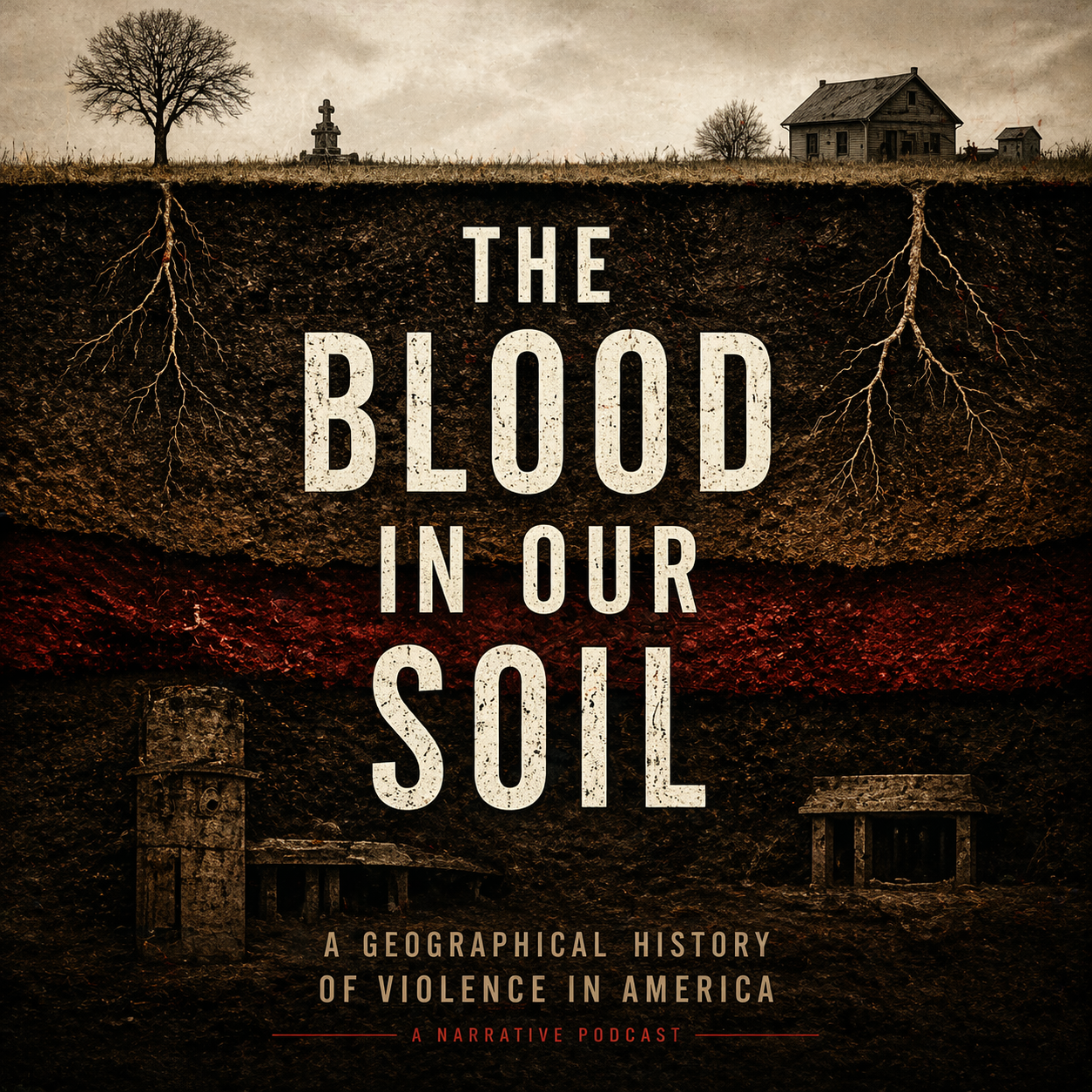
Listen here · 14:07
Episode 1: Lawrence County, Tennessee
Anonymous listening milestones help us understand how the episode is being heard. No names or email addresses are collected.
Episode notes
A place where violence is remembered—and redirected.
The story begins with a nameless couple said to have been dragged to death for refusing to surrender their meager wealth. But the murder legend is not the beginning. The soil beneath it is already saturated.
Moving between the road, the archives, David Crockett State Park, and Lawrenceburg's public memory, the episode asks how a place can tell one story of violence so insistently that older and more organized forms of violence become easier to overlook.
This episode discusses forced removal, enslavement, racial violence, murder, lynching, and the deaths of children.
In this episode
Land, myth, and accumulated history
- 01
Chickasaw dispossession and the 1816 land cession
- 02
The Cherokee Trail of Tears through Lawrence County
- 03
Davy Crockett, frontier mythology, and the Creek War
- 04
Slavery, the Civil War, and the changing forms of racial control
- 05
A roadside murder legend and the violence local stories obscure
AccessibilityRead the complete episode transcript
This transcript has been lightly edited for readability. Significant sound cues appear in brackets.
Across the United States, violence is written into the landscape—sometimes visible, more often hidden beneath the surface. This is a podcast about what the land holds, and what it refuses to forget.
I’m Tomi Castle-White, and I’m glad you’re here.
Because there is blood in our soil.
And the land remembers.
In rural, southern Tennessee, locals tell a tale of murder and bravery, of desperation and poverty, of war and loss.
Running through the disparate elements, cobbled together from legend, recollection of long-dead elders’ memories, and outright invention, is blood. The blood shed in birthing beds and battlefields and shared through generations. It begins down a dirt road south of Nebo, Tennessee.
Locals here tell me that two unadorned stones in a roadside ditch mark the resting place of a couple dragged to death behind horses for refusing to surrender their meager wealth to a pair of would-be thieves turned murderers. The road where it happened, still unpaved and now closed to traffic, is similarly unmarked and unnamed.
In Lawrence County, Tennessee, the blood in the soil long predates the murder story set on that unnamed road.
Before there were county lines, before there was a Lawrenceburg, before the highway cut through the hills and the railroad crossed the river bottom, this land belonged to other people.
The county itself was carved from land purchased from the Chickasaw in 1816. Or rather, land said to have been purchased. The language of purchase contracts has always come so easily to Americans. It sounds clean. Orderly. Voluntary even.
But the map tells another story.
Because twenty years later, after the county had been surveyed and parceled and fenced, those same roads and river crossings became part of the machinery of removal.
[Wagon wheels. Wind through trees.]
In 1838, Cherokee families passed through Lawrence County on the Trail of Tears. They crossed Shoal Creek Ford. They followed the road that now runs beside gas stations and chain restaurants and a state park gift shop.
Today, you can visit a reconstructed section of that route at what is now a designated “point of interest” in David Crockett State Park. There’s an interpretive trail. A few signs. A path through the trees.
But the land remembers more than signs can say.
It remembers exhausted people walking west under armed guard.
It remembers children shivering and dying beside the road.
It remembers that Lawrence County wasn’t just settled through dispossession. It was built atop it.
And then there is Davy Crockett himself.
In Tennessee, Crockett survives less as a person than as a folk saint. There are schools named for him, parks named for him, statues and murals and stories about him. The rough frontiersman. The man of the people. The coonskin cap. The rifle. The joke.
In Lawrence County, his name is everywhere. On an elementary school. On a theater. On a cinema. On a museum in his honor. A bronze Crockett statue, over a hundred years old, serves as the centerpiece of the town square. A marker stands where his home once stood.
But beneath the myth is a much harder story.
Crockett came to Lawrence County after failing politically in East Tennessee. Here, he rebuilt himself as a frontier hero: a hunter, landowner, businessman, and eventually a politician who spoke for poor white settlers while also owning enslaved people himself.
He understood something that American politics would learn again and again: that a man can present himself as the champion of ordinary people while still standing atop a system of exploitation.
Crockett opposed the Indian Removal Act in Congress. That much is true.
But he had already participated in the violence that made removal possible.
In 1813, during the Creek War, Crockett joined Andrew Jackson’s forces in an attack on the Red Stick town of Tallushatchee. Years later, he proudly described how the soldiers killed men, women, and children and burned a home with dozens of people inside.
[Fire crackles, then silence.]
The language he used is striking not only for its brutality, but for its familiarity. He described the dead as though they were animals. He called the bodies of the people he killed “carcasses.”
Violence requires a certain kind of geography.
Not only a place, but a way of seeing the people in that place.
You must first convince yourself that the land is empty, or that the people already there do not fully belong to it. That they’re not fully people at all.
Only then can you murder them and take it.
And Lawrence County was taken, over and over again.
First from the Chickasaw. Then through the expulsion of the Cherokee. Then through slavery.
By 1860, Lawrence County was no longer a frontier in the usual sense. The forests had been cleared. Cotton grew in the river bottoms. Iron was pulled from the earth. Small factories turned raw fiber into cloth.
But beneath all of this growth was enslaved labor.
Fewer than a quarter of households in the county owned enslaved people. If you bring up slavery, you’ll hear some variation of that fact. Indeed, it’s often repeated, usually to suggest that slavery here was somehow marginal. Incidental. Less brutal, perhaps, than elsewhere.
It was not.
Because slavery, like war or poverty or disease, does not have to be universal to shape a place.
It only has to be powerful.
Along the Tennessee River bottom, enslaved people planted and picked cotton. Others worked in iron ore mines and forges. Others labored in the county’s cotton factories. The 1850 census recorded more than one hundred enslaved Black people in the area, along with dozens more classified in the language of the census as “mulatto.”
The records list numbers. Ages. Sexes.
Almost never names.
A county archive can tell you that one man owned twelve people, another owned twenty, another thirty.
It can tell you what they were worth.
It usually cannot tell you who they were.
That erasure, too, is a kind of violence.
The violence of making people disappear from the historical record even while their labor built the world around you.
The roads. The fields. The houses. The factories.
The wealth.
[A distant church bell.]
When Tennessee voted to leave the Union in 1861, Lawrence County followed much of Middle and West Tennessee in supporting the Confederacy, but the state was deeply divided.
East Tennessee voted overwhelmingly against secession. But elsewhere, support for the Confederacy rested on a familiar foundation: the defense of slavery, and the belief that the wealth and status of white people depended upon it.
Tennessee became the last state to formally join the Confederacy.
And then the war came.
Like most wars, it promised glory and delivered ruin.
The men who owned the most land and the most enslaved people often survived. The poor fought. The poor died.
When the Confederacy collapsed, many of Lawrence County’s former slaveholders lost their fortunes. Some went bankrupt. Others rebuilt their wealth through sharecropping, debt, and wage labor.
Freed people were no longer property. But freedom did not bring land, or money, or safety.
Many remained on the same farms, working for the same families that had once claimed to own them.
The old forms did not disappear. Indeed, not fifty miles from Nebo is Pulaski, birthplace of the KKK.
No, the old forms did not disappear. They just changed shape.
And somewhere inside the collapse of Tennessee’s antebellum society, inside the poverty and resentment and humiliation that followed the war, is the beginning of the story people still tell about those two stones way out in the woods.
Because when people lose what little they have, they look for someone to blame.
Sometimes they blame the wealthy men who built their fortunes on other people’s suffering.
But more often, they blame the outsider.
The stranger. The immigrant. The carpetbagger. The person who arrives after the damage is already done and becomes a convenient explanation for a wound that is so much older.
By the time we reach that road south of Nebo, the soil is already saturated.
With removal. With slavery. With war. With dispossession.
The murder story is not the beginning.
It is only one more layer.
And what it obscures is far more important than what it reveals: that this place, beneath its veneer of bucolic beauty and social graces, is soaked in blood and resentment and human depravity.
But it’s also a place of hope. A place where literacy rates have climbed to over 92%, significantly ahead of the national average; a place where town square revitalization has spurred economic development and civic pride; and a place where locals are willing to discuss not just where to find the best barbecue or iced tea but also the state of national politics and the role of compassion in Christianity.
Today, you can walk that land.
There are trails now. Picnic shelters. A playground.
Children climb and run and laugh in a place where, less than two centuries ago, other children walked under armed guard, hungry, sick, and dying beside the road.
There’s a gift shop.
You can buy stuffed bears.
Which is, in its own way, a kind of irony.
Because the bears are mostly gone.
Crockett himself claimed to have killed forty-seven in a single month.
Violence leaves marks on the land.
Sometimes in what is remembered.
Just as often in what is no longer there.
And then there is the story people still tell about those two stones in the woods.
The couple—married, but childless.
Poor.
They had little to give.
When the men came—northern men, strangers—they demanded whatever the couple had.
Money. Valuables. Anything.
The couple refused.
So the men tied them to their horses and dragged them down that road.
The idea, people say, was that the pain would make them talk.
That they would give up where they had hidden their meager wealth.
They didn’t.
They died before they said anything at all.
[Silence.]
And that, in the telling, is the point.
Not whether it happened this way. Not whether it happened at all.
But that it could have.
The couple’s namelessness is crucial.
They’re interchangeable.
Standing in for anyone.
For poor white southerners who had already lost nearly everything—and who imagined themselves still capable of heroic resistance, even in the face of death.
Unbroken.
Unyielding.
But the story does something else, too.
It gives violence a direction.
It casts it outward.
Cruelty comes from somewhere else.
From outsiders.
From men who arrive, take, and destroy.
And in doing so, it obscures something far more difficult to confront:
That the land was already saturated with outsiders, with violence, long before those men ever arrived.
And this kind of violence—the cruel killing of innocent people—is not unique to this story.
It will happen again, and not just in stories.
Thousands of times.
In the decades after the Civil War, more than four thousand people will be lynched in the American South.
More than two hundred in Tennessee alone.
At least some in exactly this way.
Dragged.
Tortured.
Killed in public.
But the targets will change.
And the story will not be told the same way.
[Wind rises.]
So the road south of Nebo does not just hold one story.
It holds layers.
Removal.
Slavery.
War.
Resentment.
Myth.
And the quiet work of forgetting.
Today, it looks like a place where nothing happened.
A place you could pass without noticing.
A place where children play.
Where families gather.
Where you can buy a stuffed bear and walk a marked trail and believe, if you want to, that the past has been settled.
But it hasn’t.
Because there is blood in our soil.
And the land remembers.
Next in the series
Old Town San Diego: Violence Curated
The next episode travels across the continent to a landscape where violence is preserved, framed, and sold as history.
Explore the complete season