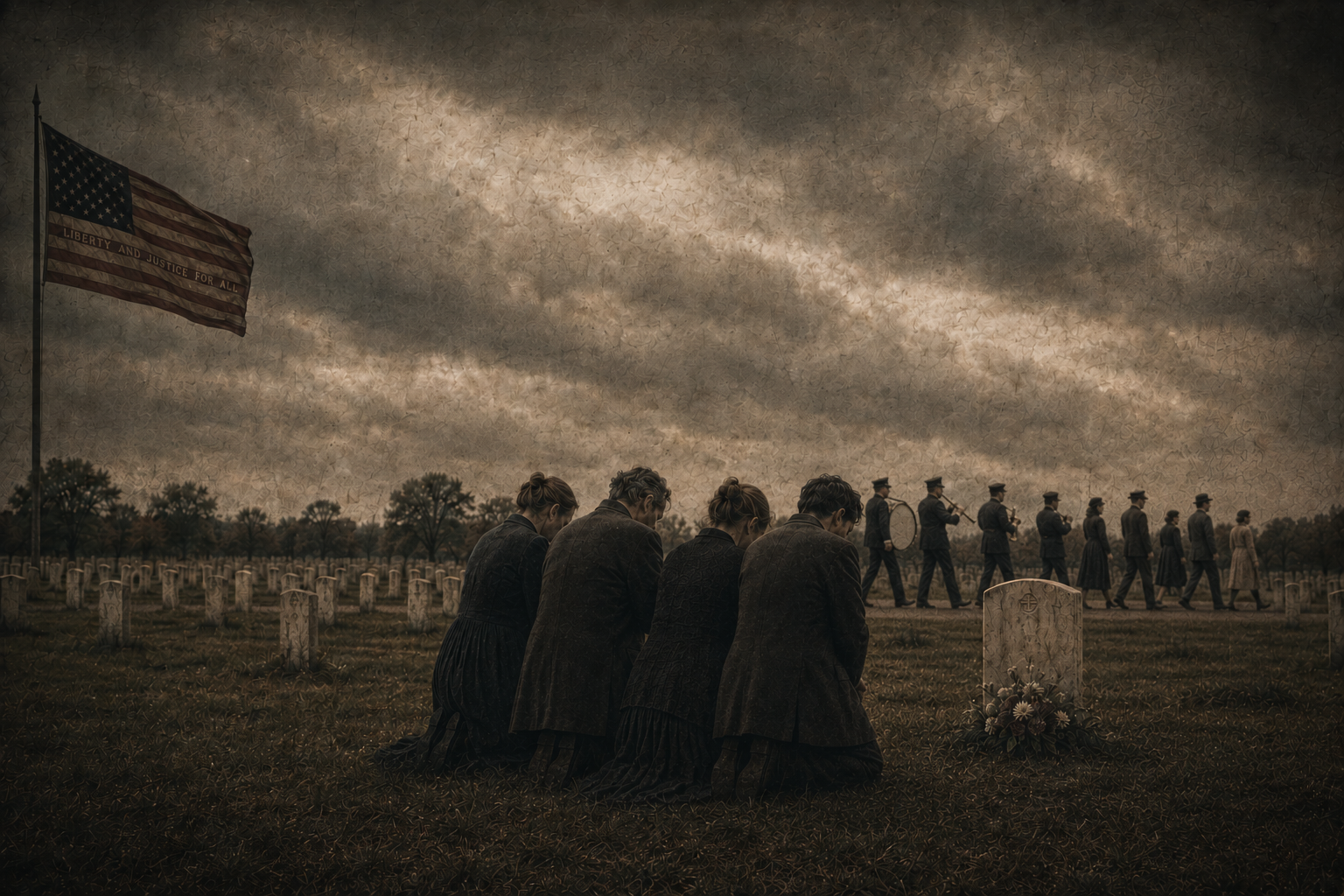
Today, Americans will place small flags beside white headstones. Wreaths will be laid. Names will be read aloud. Bands will play, politicians will speak of sacrifice, and families will stand beside graves carrying memories that are not abstractions at all.
The ritual matters. But ritual also creates a dangerous comfort: the feeling that, because we have performed remembrance, we have remembered enough.
Memorial Day is supposed to make a nation remember. But national memory is never only about what we preserve. It is also about what we permit ourselves to forget.
Every act of memorialization draws a frame around the past. Inside the frame are names, dates, uniforms, battles, and sacrifice. Outside it are the questions that make remembrance uncomfortable: Why did these people die? What did their deaths defend? What did the nation learn, and what did it choose not to learn?
Memorial Day grew from many acts of mourning after the Civil War and was formalized as Decoration Day in 1868, when Americans were called to decorate the graves of Union soldiers. From its beginning, then, the holiday was about more than private grief. The dead belonged to families, but their deaths also belonged to a national argument over what the United States was and what it might become.
The Civil War preserved the Union, but it was not simply a war about national togetherness. It was a war over slavery and over whether a nation that spoke endlessly of liberty could continue to hold human beings as property. Yet, in the decades that followed, public memory often softened that conflict into a shared tragedy between two honorable sides. Reconciliation became easier when slavery and emancipation were pushed to the edges of the story.
Memory can be generous to the dead and short-change the cause.
The same danger shadows how we remember the Second World War. We honor the Americans who died fighting Nazi Germany, and rightly so. American troops entered concentration camps in 1945 and encountered evidence of crimes so vast that military leaders, including future-President Dwight Eisenhower, insisted they be documented. Even then, there was an understanding that witnesses would die, photographs would fade, and someone would eventually claim that the evidence was false.
They were right.
Holocaust denial and distortion are not relics confined to the defeated regime. They circulate openly now, repeated online and in public life as though established fact were merely one opinion among many. It is possible, apparently, to honor those who fought Nazism while doubting the genocide the regime committed. It is possible to praise the liberators while treating what they found as negotiable.
But that is not remembrance. It is ceremony.
Not every American war was just. Not every military death can be made to fit a clean, patriotic story, and pretending otherwise would be another form of forgetting. Soldiers have died in wars whose purposes remain contested and whose consequences were devastating, including to people whose names will never appear on American memorials. Respect for the dead does not require us to surrender judgment about the decisions that placed them in harm's way.
This is, perhaps, precisely why honest remembrance matters. If every death is made to symbolize the same uncomplicated virtue, then none of those deaths is allowed to tell us anything.
Still, some things were won, and those victories matter. The Civil War ended legal slavery. The defeat of Nazi Germany ended a genocidal regime and liberated people it had marked for destruction. Neither victory produced an equal world. The United States emerged from the Civil War into Black Codes, racial terror, and Jim Crow. Black veterans returned from the Second World War to segregation and violence at home. The promise remained painfully incomplete.
But incomplete is not meaningless.
What was won was not equality itself. It was a world in which a broader equality remained possible, a world in which old exclusions could be challenged with new force, and in which the nation could be held to promises it had long denied to many of its own people. The dead did not leave us a finished country. They left the living an unfinished obligation.
This is why the flags matter, if they matter at all. Not because repetition makes a symbol sacred, and not because display proves loyalty. A flag draped over a coffin or planted beside a grave carries a claim about what the nation believes those deaths were for. If it points only backward, toward glory and grief, it asks almost nothing of us. If it points toward promises not yet kept, then it becomes an obligation.
Memorial Day creates a geography of memory. Cemeteries, battlefields, town squares, courthouse lawns, and monuments tell us where to look and what to see. But these places do not simply preserve history. They organize it. They decide whose deaths become visible, which causes are named, and which contradictions linger outside the frame.
If you have been listening to this podcast, you already know where this leads me. Landscapes remember, but they do not speak without interpretation. A memorial can preserve a name while obscuring a cause. A monument can make one story permanent while crowding another out. The stone remains, but its meaning depends on what the living are willing to confront.
I am not interested in telling anyone not to place a flag or attend a parade. But I am interested in asking what, exactly, we remember when we do.
Do we remember only that Americans died, or also what they confronted? Do we remember only what the nation lost, or what their deaths made possible? Do we treat sacrifice as the end of the story, or as a debt passed on to those who survived?
To remember the fallen without remembering what made their sacrifice matter is to turn memory into pageantry. It leaves us with symbols emptied of their demands, history stripped of its warnings, and patriotism without obligation.
The dead do not need us to make their wars simple. They need us to make our memory honest.
And that, perhaps, is the lesson we most need to remember.